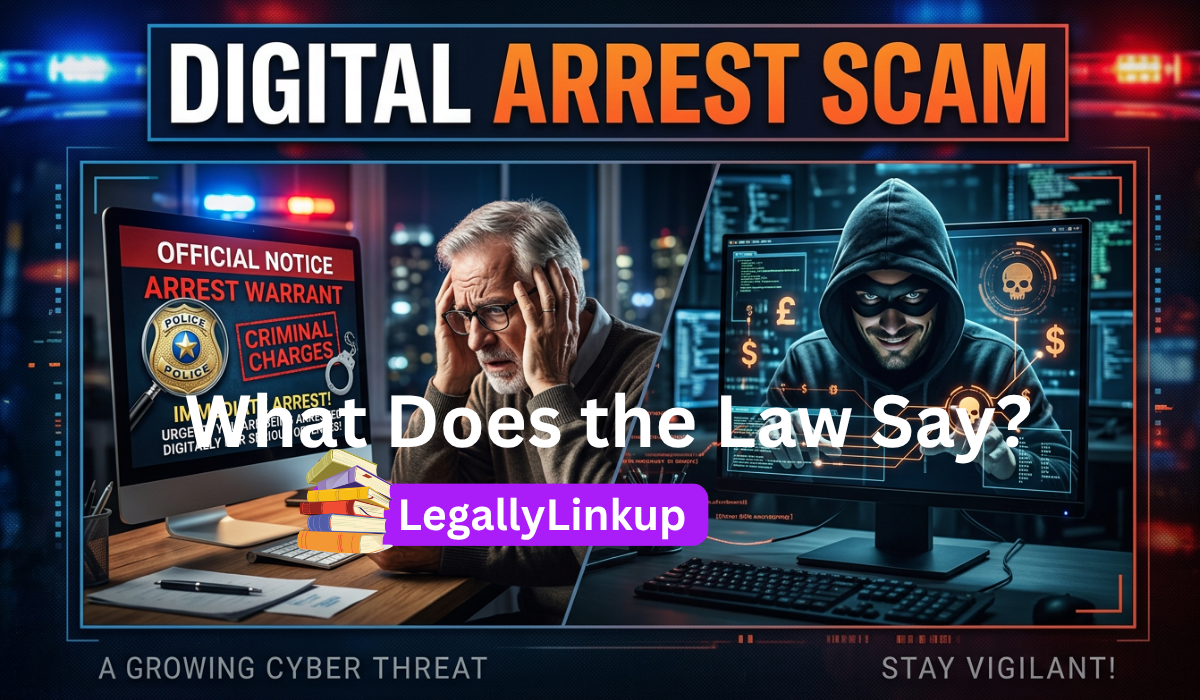
The digital arrest scam in India is a sophisticated cyber fraud in which criminals impersonate police officers, CBI officials, RBI representatives, Enforcement Directorate officials or other government authorities. They falsely accuse victims of being involved in a crime and threaten them with arrest unless they pay money or follow the scammers’ instructions.
The important fact to remember is simple: there is no concept of “digital arrest” under Indian law. The Indian Cyber Crime Coordination Centre (I4C) has specifically warned that genuine law-enforcement authorities do not conduct arrests through video calls.
What Is a Digital Arrest Scam?
A digital arrest scam is an online extortion scheme based on fear, impersonation and psychological pressure.
Typically, the scam begins with a phone call or message claiming that:
- A parcel linked to your identity contains illegal items.
- Your Aadhaar or mobile number has been used in a crime.
- Your bank account is connected to money laundering.
- You are involved in a criminal investigation.
- A family member has been arrested or is allegedly involved in an offence.
The victim is then transferred to another person claiming to be a senior police or government official.
Scammers may use fake uniforms, forged documents, spoofed phone numbers and backgrounds resembling police stations or government offices to appear genuine.
How Does the Scam Work?
A typical digital arrest scam follows several stages:
1. Initial Contact
The victim receives a call from someone pretending to be a courier company, police officer, bank official or government department.
2. False Criminal Allegation
The caller claims that the victim is connected to a serious offence such as money laundering, drug trafficking, cybercrime or another criminal activity.
3. Fake Investigation
The victim may be connected to a video call with another person posing as a senior official. Fake documents, identification cards and legal notices may be shown to create credibility.
4. Digital Confinement
The victim may be ordered to remain continuously on a video call and instructed not to contact family members, friends or lawyers. I4C describes this as “digital confinement.”
5. Demand for Money
The scammers then demand money, often describing it as a security deposit, verification amount, fine or payment to avoid arrest.
Once money is transferred, additional demands may follow.
Is Digital Arrest Legal in India?
No. “Digital arrest” is not a legal form of arrest in India.
The I4C’s official advisory states that there is no concept of digital arrest under Indian laws.
A genuine criminal investigation or arrest follows procedures established under applicable Indian law. A police officer cannot legally “arrest” someone simply by keeping them on a WhatsApp, Skype or other video call.
Therefore, a caller threatening to digitally arrest you unless you transfer money is displaying a major warning sign of fraud.
What Does the Law Say About the Scam?
Although “digital arrest” itself is not an offence category or legal procedure, the conduct involved can amount to several criminal offences.
Depending on the facts of a particular case, authorities may investigate offences involving cheating, impersonation, extortion, criminal intimidation, forgery and cybercrime, among others, under applicable laws such as the Bharatiya Nyaya Sanhita, 2023 (BNS) and the Information Technology Act, 2000.
The exact offences and sections depend on how the fraud was carried out, what was represented to the victim, whether money was obtained, and how digital systems were used.
Cybercrime complaints are investigated by the relevant State or Union Territory law-enforcement authorities.
What Should You Do If You Receive a Digital Arrest Call?
Do not panic or transfer money.
Follow these steps:
- End the call if someone threatens you with digital arrest.
- Do not share your OTP, PIN, passwords or banking information.
- Do not install remote-access applications at the caller’s request.
- Save screenshots, phone numbers, messages and other evidence.
- If money has been transferred, call 1930 immediately.
- Report the incident through the National Cyber Crime Reporting Portal at cybercrime.gov.in.
- Inform your bank or payment service provider immediately if a financial transaction has occurred.
- Consider approaching your local police or cybercrime police unit.
The Government has specifically advised citizens to report digital-arrest scams through 1930 or the National Cyber Crime Reporting Portal.
How to Identify a Digital Arrest Scam
Be especially cautious when someone:
- Threatens immediate arrest over a phone or video call.
- Demands money to “close” a criminal case.
- Orders you to stay on a video call.
- Tells you not to inform your family or lawyer.
- Requests your bank details or OTP.
- Uses official-looking documents to frighten you.
- Claims that your money must be transferred for “verification.”
Real authorities do not demand money through such methods to prevent a supposed arrest.
Final Takeaway
A digital arrest scam is a cyber fraud, not a genuine form of arrest. Criminals exploit fear of police action and use fake identities, documents and video calls to manipulate victims into transferring money.
If you receive such a call, stay calm, do not pay, preserve the evidence and report it immediately. For financial cyber fraud, contacting 1930 without delay can be particularly important because quick reporting may help authorities and financial institutions take steps to trace or stop the movement of funds.
Disclaimer: This article is intended for general legal and educational information and does not constitute legal advice. Laws and procedures may change, and the applicable legal provisions depend on the facts of each case.