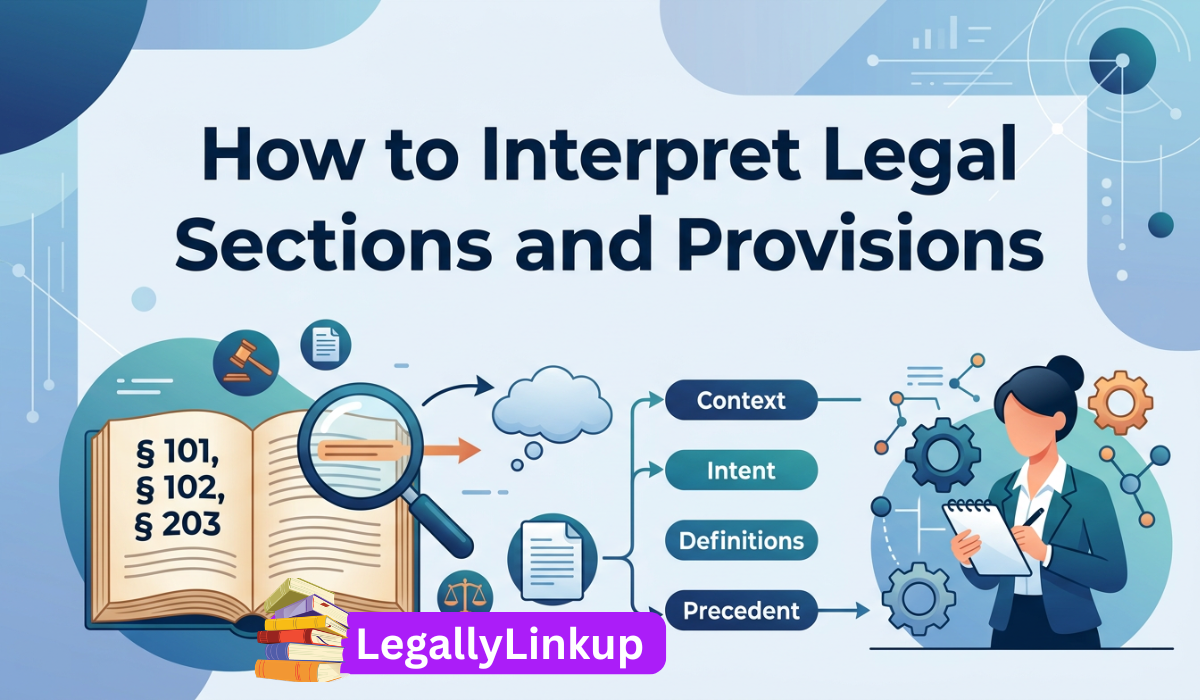
How to Interpret Legal Sections and Provisions: A Beginner’s Guide for Law Students . One of the biggest challenges for law students is understanding how to properly interpret legal sections and statutory provisions. At first glance, Bare Acts often look confusing because of:
- Complex language
- Long sentences
- Multiple clauses
- Exceptions and provisos
- Technical terminology
Many students read a section several times and still feel unsure about its meaning. But legal interpretation is one of the most important skills in law school and legal practice. Whether you want to become a litigator, corporate lawyer, judge, legal researcher, or judiciary aspirant in India, learning how to interpret statutes properly is essential. This guide explains legal interpretation in a simple and practical way for beginners.
What Is Legal Interpretation?
Legal interpretation means understanding the meaning, scope, and purpose of a legal provision.
Courts interpret statutes to determine:
- What the law means
- How it applies
- What rights or obligations exist
- Whether exceptions apply
Interpretation helps resolve legal disputes and clarify legislative intent.
Why Interpretation Skills Matter for Law Students
Strong interpretation skills help students:
- Understand Bare Acts better
- Improve legal reasoning
- Write stronger exam answers
- Analyze case laws
- Perform better in internships
- Build courtroom confidence
Every legal professional regularly interprets statutes.
Why Legal Sections Feel Difficult
Legal provisions may seem difficult because they often contain:
- Formal legal language
- Multiple conditions
- Cross-references
- Technical definitions
- Exceptions and provisos
The solution is not memorization.
The solution is structured reading.
Step 1: Read the Section Slowly
Do not rush.
Many students try to read legal provisions too quickly.
Instead:
- Read one sentence at a time
- Identify important words
- Pause after each clause
Law requires careful reading.
Step 2: Identify the Main Rule
Every legal provision usually contains a central rule.
Ask:
What is this section primarily saying?
Example:
A contract law provision may define when agreements become enforceable.
Focus on the core idea first.
Step 3: Break the Section Into Parts
Long sections become easier when divided into smaller parts.
Separate:
- Main rule
- Conditions
- Exceptions
- Provisos
- Explanations
This improves clarity.
Step 4: Understand Definitions
Legal words often have specific statutory meanings.
Students studying laws like:
- Indian Contract Act, 1872
- Transfer of Property Act, 1882
- Constitution of India
Must carefully read definition sections.
One legal word can change the meaning of an entire provision.
Step 5: Look for Keywords
Certain words are extremely important in legal interpretation.
Examples:
- Shall
- May
- Must
- Includes
- Means
- Provided that
- Subject to
These words affect legal obligations and interpretation.
Step 6: Understand “Shall” vs “May”
This is one of the most important interpretation concepts.
“Shall”-Usually indicates mandatory obligation.
“May”-Usually indicates discretion or possibility.
Courts often analyze these words carefully.
Step 7: Learn the Meaning of Provisos
A proviso usually creates:
- An exception
- A limitation
- A condition
Provisos often begin with phrases like:
“Provided that…”
Students should never ignore provisos.
Step 8: Read Explanations Carefully
Explanations help clarify legislative intent.
They may:
- Define scope
- Remove ambiguity
- Clarify interpretation
Explanations are important for exams and practice.
Step 9: Understand Legislative Purpose
Ask:
Why was this law created?
Understanding purpose improves interpretation.
For example:
- Consumer laws protect consumers
- Contract laws regulate agreements
- Property laws regulate ownership rights
Purpose often guides interpretation.
Step 10: Use Real-Life Examples
Law becomes easier when connected with practical situations.
Example:
While studying contract law, imagine:
- Business agreements
- Service contracts
- Online transactions
Practical thinking improves interpretation skills.
Step 11: Cross-Reference Related Sections
Many provisions connect with other sections.
Students should check:
- Definitions
- Exceptions
- Related procedures
- Linked provisions
Law works as a complete structure.
Step 12: Study Judicial Interpretation
Courts often explain difficult provisions through judgments.
Students should study landmark decisions from courts such as:
- High Courts
- Supreme Court of India
Judgments help students understand practical application.
Common Rules of Interpretation
Law students often study basic interpretation principles.
- Literal Rule-Words should generally be understood in their ordinary meaning.
- Golden Rule-Courts may avoid interpretations leading to absurd results.
- Mischief Rule-Courts may examine the problem the law intended to solve.
Purposive Interpretation
- Courts may interpret provisions according to legislative purpose.
- These principles become important in advanced legal studies.
Common Mistakes Law Students Make
Avoid these common errors.
1. Memorizing Without Understanding
Better Approach:-Focus on meaning and application.
2. Ignoring Definitions
Better Approach:-Always check definition clauses first.
3. Skipping Provisos
Better Approach:-Read exceptions carefully.
4. Reading Too Fast
Better Approach:-Interpret step by step.
Best Subjects to Practice Interpretation Skills
Students can improve interpretation by reading:
- Constitution of India
- Contract law
- Property law
- Criminal procedure
- Civil procedure
These subjects involve heavy statutory interpretation.
How to Practice Legal Interpretation Daily
Students can improve by:
- Reading one section daily
- Breaking sections into parts
- Summarizing provisions
- Comparing related sections
- Studying judgments
- Discussing interpretation with peers
Consistency improves legal thinking.
Useful Official Legal Resource
Students may refer to updated legal texts through:
India Code
Reading updated statutes is important.
Final Thoughts
Legal interpretation is one of the most valuable skills a law student can develop. Strong interpretation skills improve:
- Exams
- Internships
- Moot courts
- Legal drafting
- Courtroom confidence
- Professional legal reasoning
Every experienced lawyer once struggled with statutory language. The difference comes through practice. Read slowly. Analyze carefully. Think practically. Over time, legal provisions will begin to make much more sense.