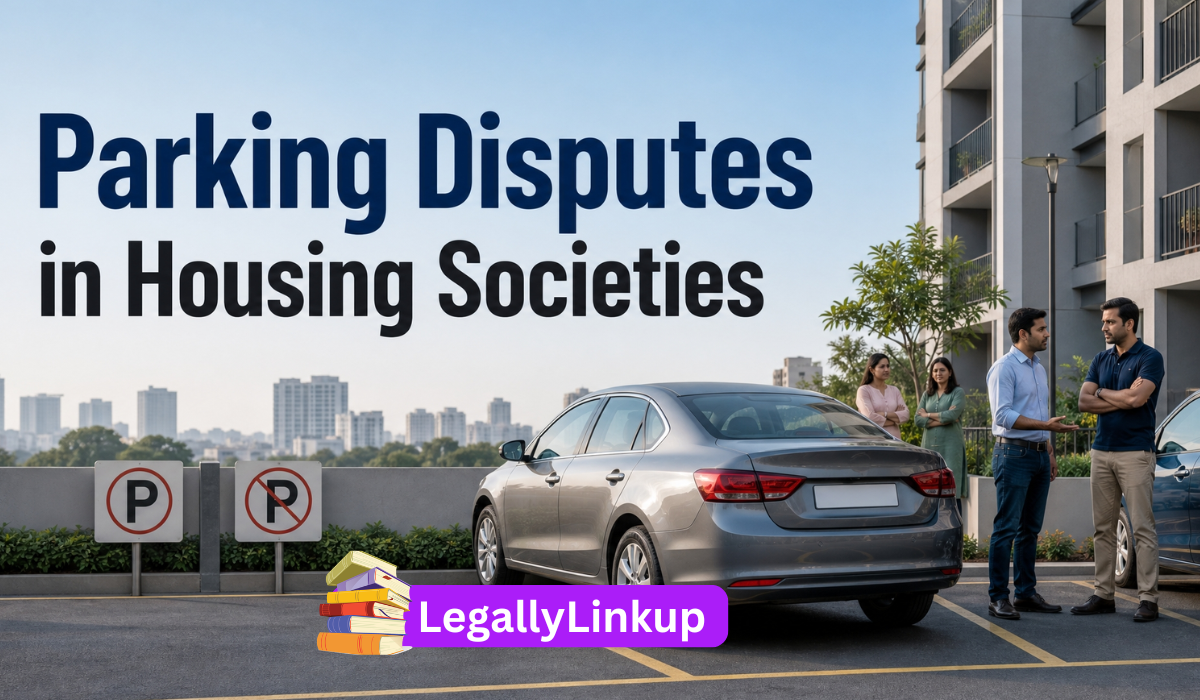
Parking is one of the most common sources of disputes in housing societies. As the number of vehicles increases, disagreements often arise between residents regarding parking spaces, allocation methods, visitor parking, and unauthorized use of common areas.
Understanding the legal position and society rules related to parking helps members resolve conflicts and protect their rights.
Why Do Parking Disputes Occur in Housing Societies?
Parking disputes usually happen because of limited parking space and unclear understanding of society rules.
Common reasons include:
- Disagreement over parking allocation
- Unauthorized occupation of parking areas
- Members claiming ownership over common parking spaces
- Visitor vehicles blocking assigned areas
- Disputes between residents and the managing committee
- Lack of proper parking management
Most parking issues are resolved by applying the society’s registered bye-laws and applicable housing laws.
Is a Parking Space Automatically Owned by a Flat Owner?
A common misunderstanding is that buying a flat automatically gives ownership over a parking space.
Generally, parking areas in a housing society may be classified as:
- Open parking spaces
- Stilt parking areas
- Covered parking areas
- Common areas managed by the society
The rights related to parking depend on the legal documents, approved plans, and society rules.
A member may have the right to use an allotted parking space, but it does not always mean they own that space separately from the flat.
Role of Society Bye-Laws in Parking Matters
Society bye-laws usually provide rules regarding:
- Parking allocation
- Use of common areas
- Parking charges
- Visitor parking
- Penalties for violations
The managing committee must follow these rules while making parking decisions.
The committee cannot arbitrarily give special preference to certain members or create unfair restrictions.
Rights of Housing Society Members Regarding Parking
1. Right to Fair Allocation
Members have the right to expect a fair parking system.
If parking spaces are limited, the society may create a reasonable allocation method based on:
- Availability
- Society decisions
- Approved rules
- Member requirements
2. Right to Use Common Parking Areas
Common parking spaces should be managed for the benefit of members.
No individual member should permanently occupy common areas without proper approval.
3. Right to Question Unfair Decisions
Members can raise objections if:
- Parking rules are applied unfairly
- Certain members receive special benefits
- Common parking is misused
They can request clarification from the managing committee.
Duties of Members Regarding Parking
Residents also have responsibilities, including:
- Parking only in allotted spaces
- Following society parking rules
- Not blocking entrances or emergency areas
- Respecting other members’ parking rights
- Maintaining vehicle-related discipline
Proper parking behavior helps avoid unnecessary conflicts.
Common Types of Parking Disputes
Unauthorized Parking
A person may occupy another member’s assigned parking space or use common areas without permission.
The society can take action according to applicable rules.
Visitor Parking Problems
Visitor parking areas are often misused when residents permanently occupy them.
Societies can create clear visitor parking guidelines.
Multiple Vehicle Issues
Some societies face problems when one member uses multiple parking spaces while others have none.
The society may frame reasonable rules for fair distribution.
Parking Charges Disputes
Members may disagree over parking fees or additional charges.
Such charges should be based on valid society decisions and applicable rules.
How to Resolve Parking Disputes?
1. Discuss With the Managing Committee
The first step is usually to approach the society committee and explain the issue.
A written complaint is helpful because it creates a record.
2. Raise the Matter in a General Body Meeting
If the issue affects multiple residents, it can be discussed during a general body meeting.
Members can suggest solutions and request changes in parking arrangements.
3. Seek Help From Co-operative Authorities
If the dispute is not resolved internally, members may approach the appropriate co-operative authority depending on the nature of the issue.
4. Take Legal Advice
For serious disputes involving ownership rights or violation of law, legal advice may be required.
Tips to Avoid Parking Disputes
Residents can prevent conflicts by:
- Reading society parking rules
- Keeping proof of allotted parking
- Avoiding arguments and using proper complaint procedures
- Following approved parking arrangements
The society should maintain clear records of parking allocation.
Conclusion
Parking disputes are common in housing societies, but most issues can be resolved through proper rules, communication, and cooperation. Members have rights regarding fair use of parking facilities, but they must also respect society regulations.
A transparent parking system benefits everyone and helps maintain a peaceful residential environment.